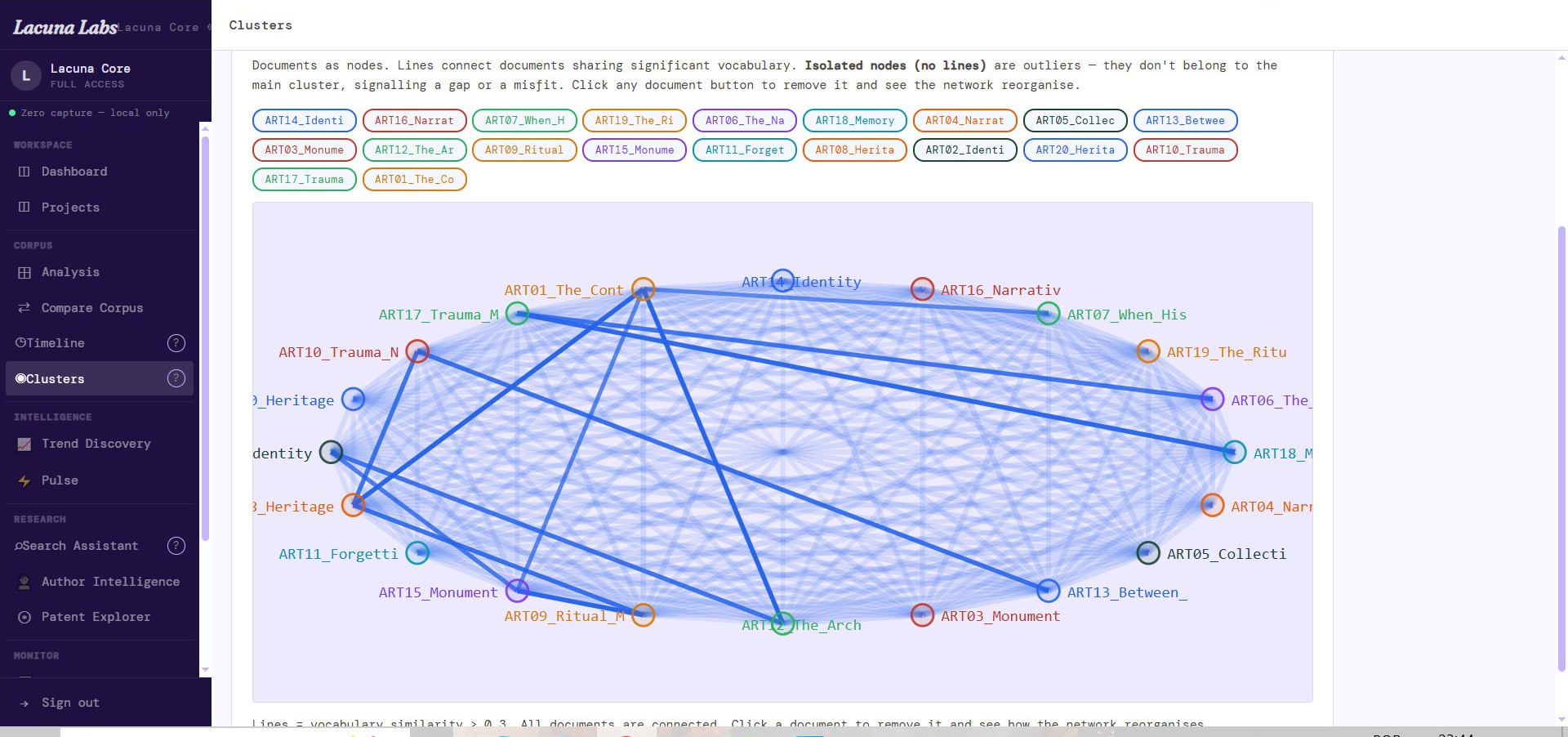
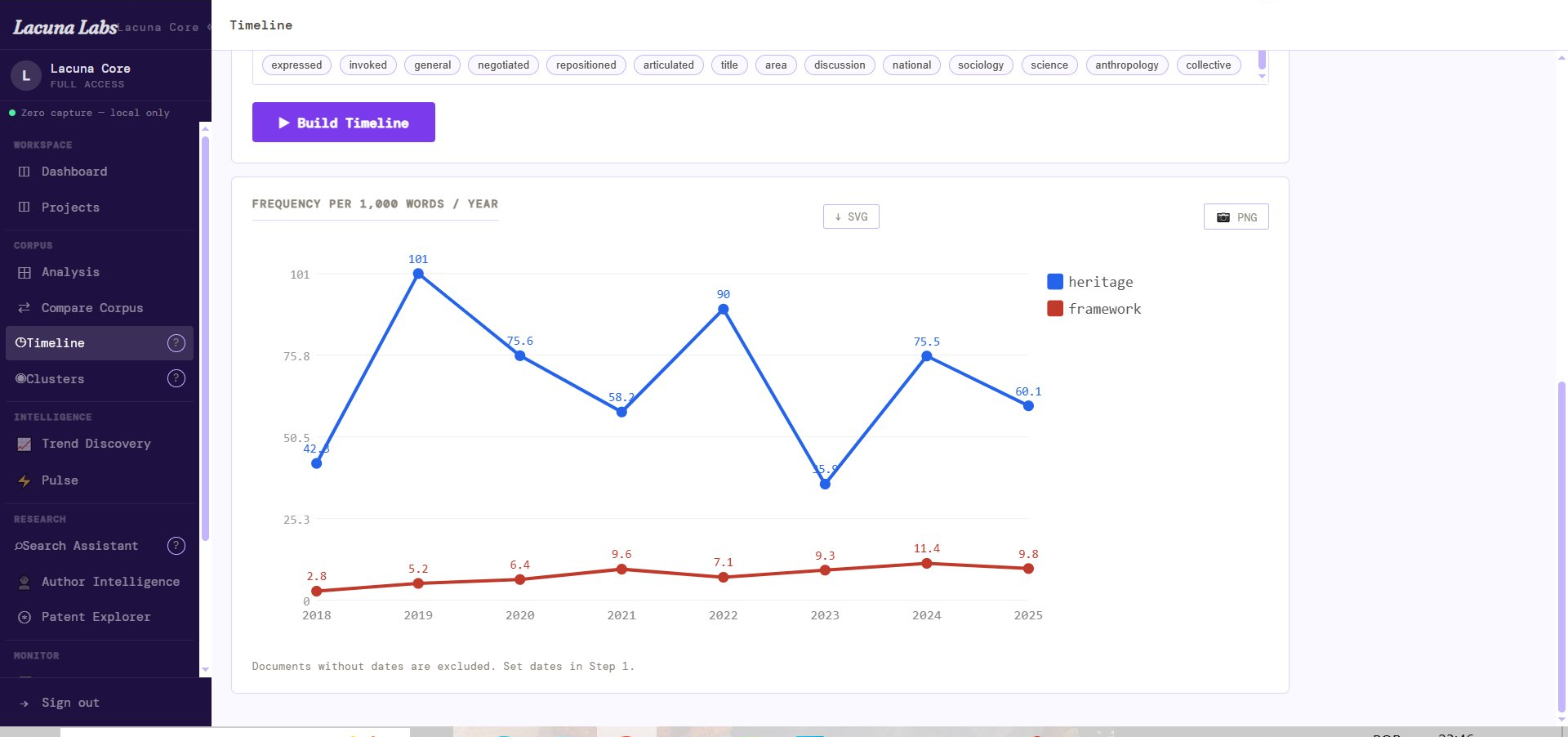
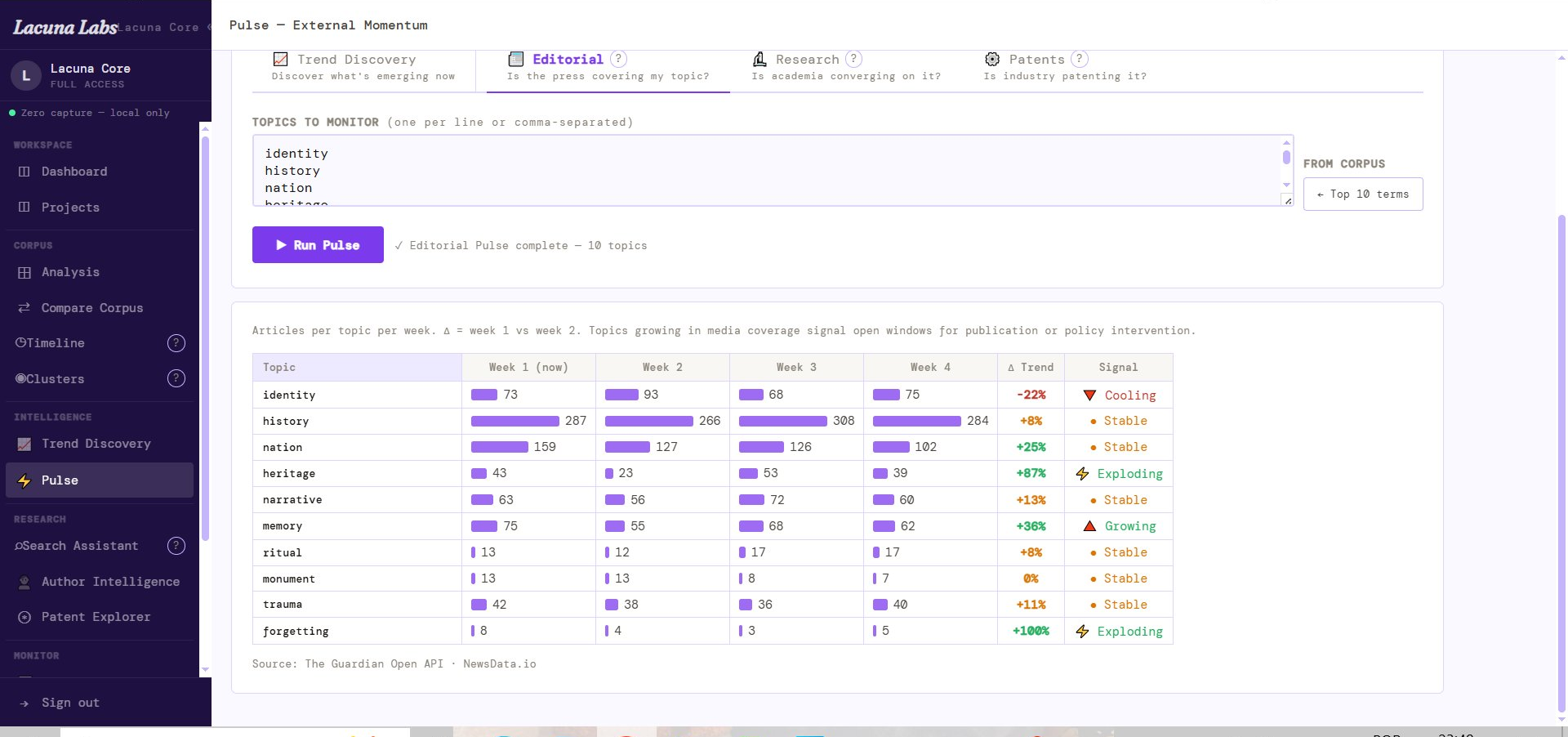
Find the gap the literature is ignoring — with evidence any peer reviewer can reproduce.
You have documents. Gaptrium™ finds what's missing. Analyse hundreds of files in seconds — entirely in your browser. Zero upload.
AI tools hit a wall. Gaptrium™ doesn't.
Every AI platform has hard limits — 5–20 files per session, 10–25 MB per file. Not a pricing tier. An architectural constraint that cannot be removed regardless of plan.
Most research tools process your documents on their servers. Gaptrium™ does not — and cannot. The architecture makes it structurally impossible for your files to reach us.
We hold no certifications. We don't need to: we simply don't receive your documents. For consultancies handling pharmaceutical dossiers, HTA submissions, regulatory filings, and legally privileged material — an architecture that eliminates the problem is stronger than a policy that manages it.
Any domain that produces documents has gaps in those documents. Gaptrium™ finds them — deterministically, reproducibly, and without sending your data anywhere.
| Review type | Category | Description | Main fields | Gaptrium™ features |
|---|---|---|---|---|
|
Systematic review
Gold standard
|
Quantitative | Exhaustive search with explicit inclusion/exclusion criteria, critical appraisal and narrative or quantitative synthesis. Highest methodological rigour. | Clinical medicine, pharmacy, public health, psychology, nursing | Heat Map PRISMA 2020 MeSH/DeCS Evidence Gap Map Merge & Dedup PICO Analysis |
|
Meta-analysis
Statistical pooling
|
Quantitative | Statistical technique that pools quantitative results from multiple studies. Usually embedded within a systematic review. Requires study homogeneity. | Clinical medicine, epidemiology, HEOR, psychology, education | Gap Analysis Co-occurrence Timeline PRISMA 2020 Corpus comparison |
|
Scoping review
Arksey & O'Malley
|
Scoping | Maps the extent and nature of evidence without formal quality appraisal. Identifies gaps to inform future research. No synthesis of effect sizes. | Public health, nursing, social sciences, health policy, education | Evidence Gap Map Heat Map Gap Analysis Freq×Coverage Word Cloud |
|
Integrative review
Whittemore & Knafl
|
Mixed | Synthesises empirical and theoretical literature simultaneously, including qualitative and quantitative studies. Suited to mature topics with diverse evidence. | Nursing, education, social work, health services research | Gap Analysis Consensus Polarity Heat Map Co-occurrence |
|
Meta-synthesis
Meta-ethnography
|
Qualitative | Integrates qualitative studies through thematic analysis or meta-ethnography. Seeks new overarching concepts rather than effect size pooling. | Nursing, social sciences, education, anthropology, mental health | Polarity Consensus Gap Analysis Co-occurrence AI Advisor |
|
Umbrella review
Review of reviews
|
Quantitative | Synthesises evidence from multiple existing systematic reviews on the same topic. Provides highest-level overview. Used to inform clinical guidelines. | Clinical medicine, public health, pharmacology, HTA agencies | Compare Corpus Bridge Map Gap Analysis Evidence Gap Map Merge & Dedup |
|
Rapid review
Time-constrained
|
Quantitative | Streamlined systematic review with simplified steps to meet policy timelines. Trades methodological completeness for speed. Used by HTA and government agencies. | Health policy, HTA, government agencies, emergency public health | Merge & Dedup Heat Map Search Log PRISMA 2020 Gap Analysis |
|
Mapping review
Evidence map
|
Mapping | Categorises and visualises the volume and distribution of evidence across a field. Identifies clusters and deserts of evidence without appraising quality. | Environmental science, international development, education, public health | Evidence Gap Map Geo Gaps Freq×Coverage Timeline Heat Map |
|
Realist review
Pawson et al.
|
Mixed | Theory-driven synthesis asking "what works, for whom, in what circumstances?" Analyses causal mechanisms. Suited to complex interventions. | Health services research, social policy, criminal justice, education | Consensus Polarity PICO Analysis Gap Analysis Co-occurrence |
|
Living systematic review
Continuously updated
|
Quantitative | A systematic review updated in near real-time as new evidence emerges. Requires continuous search, appraisal and synthesis. Prominent during COVID-19. | Clinical medicine, infectious disease, drug regulation, public health emergencies | Pulse Research Trend Discovery Timeline EGM Monitor Merge & Dedup |
|
Meta-narrative review
Greenhalgh et al.
|
Mixed | Traces how different research traditions studied the same phenomenon, explaining conflicting findings. Maps paradigms, not just studies. | Health services research, management science, information systems, sociology | Co-occurrence Timeline Consensus Compare Corpus Bridge Map |
|
Critical review
Analytical
|
Qualitative | Goes beyond description to analyse and evaluate the conceptual contribution of the literature. Resolves existing contradictions and identifies conceptual innovation. | Management, education, philosophy, social theory, political science | Gap Analysis Consensus Polarity AI Advisor Co-occurrence |
|
State-of-the-art review
Frontier mapping
|
Scoping | Addresses the most current developments in a field. Focuses on recent literature to identify emerging topics and research frontiers. | Computer science, engineering, biomedicine, AI/ML research | Trend Discovery Pulse Research Timeline Patent Explorer Co-occurrence (Emerging) |
Document and term limits depend on your plan. Zero capture applies on every plan — no document ever reaches our servers.
Every tool runs on the same engine — same corpus, same parameters, same result. Always.
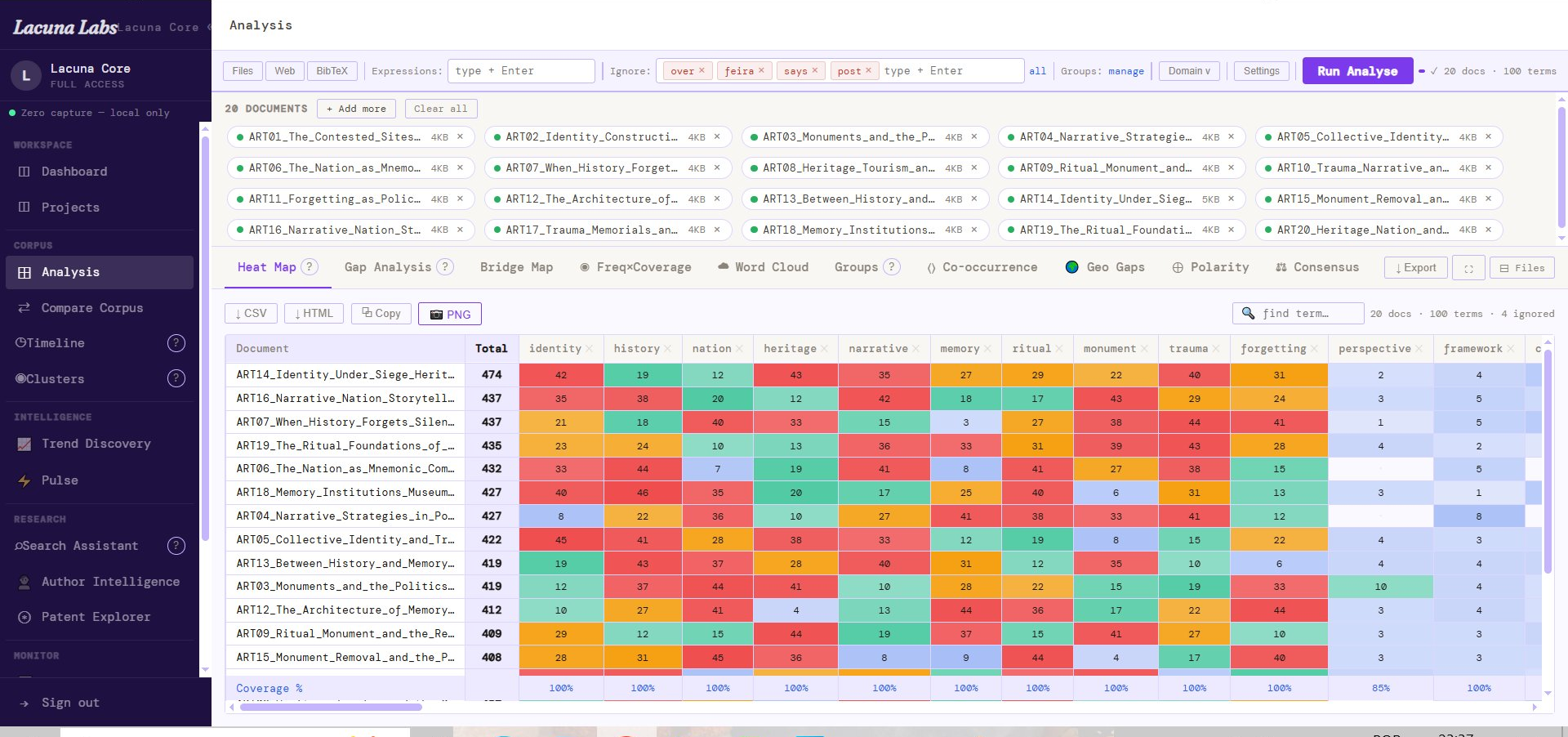
Gaptrium™ analyses massive volumes of files and cross-references the information to find the pattern of coverage. It shows how themes, data, and arguments interconnect systematically — revealing hidden connections that would escape human reading.
Gaptrium™ isolates what the documentation omitted. The software scans the data corpus and pinpoints blind spots, intentional silences in reports, and information voids that require investigation.


AI is an extraordinary tool for many tasks. But when the problem requires deterministic results, reproducible findings, and zero data exposure — AI is structurally incapable of delivering. Not because of limitations that can be fixed with a better model or a higher-tier plan. Because probabilistic inference and deterministic analysis are fundamentally different things.
Gaptrium™ fills the gap AI leaves behind — the problems that require a finding to be reproducible by any reviewer, traceable to the source, and produced without your documents ever leaving your device.
These are not weaknesses that will be fixed in the next version. They are properties of how probabilistic models work — and why a different class of tool is needed for deterministic analysis. Bibliometric tools (citation and network analysis software) are a third category worth knowing about — useful, but built for a different job.
| Capability | ✗ Generative AI | Bibliometric tools | ✔ Gaptrium™ |
|---|---|---|---|
| Document volume & file size | ✗ 5–20 files per session · 10–25 MB per file · loses context across documents · architectural constraint — cannot be fixed regardless of plan | Not applicable — no file processing; works from citation databases | ✔ No file size limit · Trial: 20 docs · Scope: 100 · Signal: 500 · Core: unlimited · bounded only by your device's processing power |
| Hallucinations & reliability | ✗ Invents facts, citations, clauses, and statistics that do not exist in the source documents. No way to detect or prevent — it is a property of probabilistic models | Not applicable — citation data only, no content generation | ✔ Zero hallucination — every output is a direct count from a specific document. Nothing is inferred, generated, or invented |
| Reproducibility | ✗ Probabilistic output changes on every run. Same question, different answer. No reviewer can reproduce or verify the finding | High — but dataset-dependent and bound by database coverage | ✔ Byte-identical results every time. Same corpus + same parameters = same result — tomorrow, next year, or in peer review. Peer-reviewed methodology |
| Gap detection | ✗ Can summarise what is present but cannot map what is missing or systematically omitted | Partial / indirect — only visible as citation gaps, not content gaps | ✔ Specialised in auditing and isolating what was not written — the absence is the finding |
| Data privacy & compliance | ✗ Documents uploaded to cloud servers. Data retained for model training. Compliance requires contractual guarantees that vary by provider and jurisdiction | Depends on hosting model — local, cloud, or hybrid by tool | ✔ Zero upload — documents never leave your device. No document data is processed or transferred by Lacuna Labs. Structurally compatible with GDPR, UK GDPR, LGPD, and Swiss nFADP obligations. Safe for classified, legally privileged, and trade secret material. |
| Pattern mapping | ✗ Loses global context in long readings. Cannot process the full corpus as a unified structure | Network and co-citation patterns only — not content patterns | ✔ Processes hundreds of files simultaneously as a single integrated corpus — full context, no memory loss |
| Auditability | ✗ Black box — opaque scoring, no traceability. Unusable for court submissions, regulatory filings, or audit sign-off | Partial — traces to citation record, not document content | ✔ Every score traces back to a specific count in a specific document. Defensible in court, regulatory review, and peer-reviewed publication |
| Peer-reviewed methodology | ✗ Proprietary, undisclosed, or general-purpose — not built for systematic review | Varies by tool | ✔ ECKM 2021 · IEEE 2023 · Cited in Springer Nature 2026 |
AI and bibliometric tool figures based on publicly documented category characteristics as of 2026. Gaptrium™ is not positioned as a replacement for AI — it addresses a class of analytical problems that probabilistic models are structurally unable to solve. Lacuna Labs does not name or endorse any specific competitor.
Unlike generative AI systems optimised for language generation and conversational assistance, Gaptrium™ is designed for structured scientific evidence processing, reproducible analytical pipelines, reduction of interpretative ambiguity in literature reviews, and deterministic workflow execution.
This positions Gaptrium™ within the category of deterministic research infrastructure for evidence-based science — adjacent to, but functionally distinct from, both generative AI assistants and traditional bibliometric tools.
References to academic literature relate to the scientific methodologies underlying the system and/or publications where related approaches are discussed in peer-reviewed research. This does not imply endorsement, certification, or validation by any academic publisher, journal, or institution.
Gaptrium™ is inspired by the MTTR methodology — published by the Intelligent Systems Research Centre, London Metropolitan University — and peer-reviewed and published in three institutional contexts: ITNG / Springer (2020), IEEE Transactions on Services Computing, and ECKM · Coventry UK (2021). It is also cited, among hundreds of other tools, in Systematic Reviews (Springer Nature, 2026). Gaptrium™ shares no code, screen or implementation with MTTR.
See the full methodology, genealogy & institutional citations →Not an AI platform — a Deterministic Intelligence Platform. Same corpus, same parameters, same result. Always. Reproducible. Auditable. Zero retention.
For: Academic Research · Media Intelligence · PR & Narrative Analysis · Commercial Due Diligence · Government & Audit
Documents are processed entirely in your browser on every plan. No file reaches our servers. Compatible with classified information, legally privileged material, and trade secrets.